
Beyond the Rice Paddy Mockery: K-Pop Banks Billions on Southeast Asia While the Region Demands Its Due
January 2026: racist slurs at a DAY6 concert. December 2026: BTS plays four nights in Singapore, three in Bangkok, two in Kuala Lumpur. Southeast Asia isn't cancelling K-pop. It's finally cashing the cheque. The debt is now overdue.
Let us speak exclusively in the language of 2025 and 2026. Not projections. Not extrapolations from years past. The ledger is now current, and its entries tell a story the industry can no longer outrun.
PART I: THE PROFIT COLUMN – WHAT SOUTHEAST ASIA HAS GIVEN
In 2025, the global K-pop market was valued at $10.56 billion. By 2033, it is projected to nearly double to $20.9 billion. Southeast Asia is not a footnote in this expansion. It is the accelerator.
2025: The Festival Year
The search results document at least six Korean acts performing across three Southeast Asian countries in 2025 alone although this is almost certainly a severe undercount.
- Malaysia (June 2025) : Pol Kim headlines the Korea-ASEAN Music Festival 2025 ROUND in Kuala Lumpur, a two-day event featuring three Korean artists alongside ASEAN performers .
- Vietnam (October–November 2025) : Korea Spotlight 2025 sells out its 1,500-capacity venue in Ho Chi Minh City. BTOB, DPR Cream, DPR Arctic, ARrC, and Dragon Pony perform. ARrC's Vietnamese member KIEN addresses the crowd in his native language; the venue erupts. KOCCA's Vietnam director states explicitly: "The creativity and passion of Vietnamese fans have inspired us greatly, and we are committed to continuing our journey with this community" .
- Vietnam (November 2025) : Kep1er, AHOF, and Na Tae-joo headline the ASEAN-Korea Music Concert: "Going Together in Viet Nam." AHOF includes a Filipino member. Proceeds are donated to the Vietnam Red Cross .
- Philippines (July 2025) : EXO's Kai holds his solo "KAION" concert at the Smart Araneta Coliseum, Manila, marking his return from military service .
2026–2027: The Blockbuster Years
If 2025 was defined by festivals and solo returns, 2026 is defined by the return of K-pop's stadium-filling titans. The search results document at least sixteen Korean acts scheduled to perform in Southeast Asia in 2026–2027, across five countries, in thirteen stadium nights—and counting.
TREASURE – "PULSE ON" Asia Tour (April–May 2026)
- Manila: April 18, SM Mall of Asia Arena
- Jakarta: April 25–26, Indonesia Arena (two nights)
- Singapore: May 3, Singapore Indoor Stadium
- Kuala Lumpur: May 30, Axiata Arena
- Bangkok: Date and venue pending
EXO – "EXhOrizon" 6th Tour (April–July 2026)
- Ho Chi Minh City: April 25, SECC Outdoor
- Bangkok: May 16–17, Impact Arena (two nights)
- Jakarta: June 7, Indonesia Arena
- Kuala Lumpur: June 20, National Hockey Stadium
- Manila: July 4–5, SM Mall of Asia Arena (two nights)
- Singapore: July 26, Singapore Indoor Stadium
K-SPARK IN MALAYSIA 2026
- Kuala Lumpur: January, 2026
- Lineup: G-DRAGON, HWASA, ITZY, DPR IAN
- Local guests: DOLLA and 3P (Malaysia)
- Note: K-SPARK sold out its 2025 Bangkok and Vietnam editions entirely
BTS – WORLD TOUR (2026–2027)
- Bangkok: December 3, 5, 6 (three nights)
- Kuala Lumpur: December 12–13 (two nights)
- Singapore: December 17, 19, 20 (three nights)
- Jakarta: December 26–27 (two nights)
- Manila: March 13–14, 2027 (two nights)
The Institutional Depth
This is not merely touring volume. This is structural dependency.
- Singapore: The Singapore Tourism Board formalised a partnership with HYBE in 2024, explicitly positioning the city-state as a regional K-pop hub . Ticketmaster listings for K-pop events in Singapore increased 250% between 2022 and 2024 .
- Indonesia: KOCCA's Jakarta branch, established in 2016, has deepened its presence. The KOREA 360 public showcase in LOTTE Mall Jakarta has hosted 119 events and attracted approximately 1.7 million visitors since its 2022 launch . A January 2026 government-organised concert featuring SHINee's Minho and Highlight drew nearly 5,000 attendees .
- Philippines: Manila Bulletin describes the capital as "the K-Pop Hub of Southeast Asia," a designation earned through relentless consumption . When BTS tour dates were announced, accommodation searches from the Philippines to South Korean concert cities increased over 700% . Filipino fans were among the most active participants in securing seats for shows in Goyang, not merely waiting for artists to arrive but travelling internationally to meet them .
- Malaysia: Market analyses project a CAGR of approximately 11% through 2028, driven by a youthful, tech-savvy demographic . K-pop video views and social media engagement have surged by over 30% annually .
This is not incidental revenue. This is structural dependency. When Western momentum falters or Chinese visas stall, the ASEAN corridor absorbs tours, streams merchandise, and stabilises quarterly earnings. Korean entertainment agencies do not gamble on this region. They bank on it. Aggressively. Quietly. Without acknowledgement.
PART II: THE DEBT COLUMN – WHAT SOUTHEAST ASIA HAS RECEIVED
31 January 2026, Kuala Lumpur. DAY6 performs at Axiata Arena. A Korean fansite master smuggles professional camera equipment into the venue, violating clear regulations. Malaysian fans document the infraction. The offender apologises. This is where the incident should have ended .
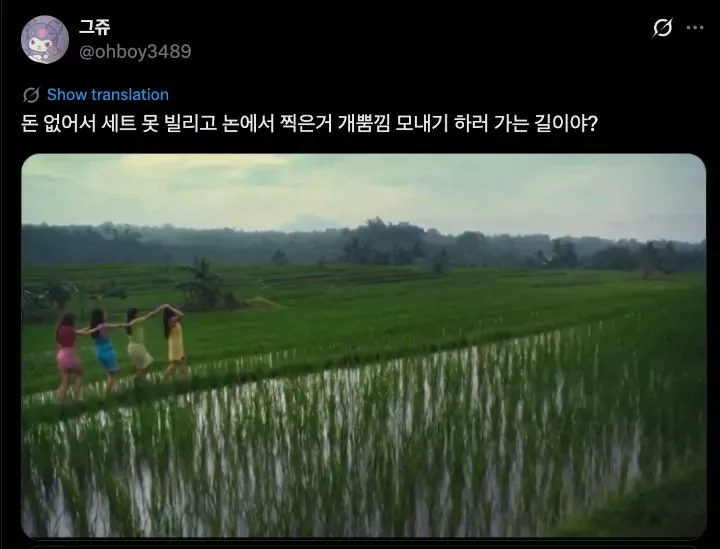
Instead, Korean netizens retaliate with racist attacks targeting Southeast Asians broadly. An ape photograph captioned "Angry Southeast Asian women." Mockery of Indonesian girl group no na's music video filmed in rice paddies: "We had no money to rent a set, so we filmed in a rice field. Are you on your way to plant rice seedlings?" .
The subtext is deliberate. Agriculture as embarrassment. Rural life as failure. Southeast Asian features as subhuman.
8–9 February 2026. The region responds. Not with cancellation, but with unprecedented solidarity. Indonesian fans, typically engaged in friendly rivalry with Malaysia, instead mobilise in defence. Vietnamese and Thai netizens join. The hashtag #SeaSibling trends. One viral post captures the sentiment: "It's almost impossible for outsiders to make us angry because we annoy each other so often. But when it comes to this, we can be united" .
A Malaysian user delivers the most culturally precise rejoinder: "Remember that you eat rice until you scrape the burnt crust soaked in water" .
Indonesian fans abandon English and Korean entirely, flooding timelines with Javanese Hanacaraka, Sundanese, Balinese, Batak, Lontara, Lampung, and Rejang scripts, an unapologetic assertion that linguistic accessibility is not their burden to carry . Another user repurposes the ape photograph with a new caption: "Korean people's original faces before plastic surgery" .
The Silence That Speaks Volumes
JYP Entertainment, which manages DAY6, has issued no statement.
The fansite operator faced no discernible consequence. No agency has announced new accountability protocols. No Korean entertainment company has publicly acknowledged that its most reliable revenue market was subjected to coordinated, dehumanising racist attacks by members of its own domestic fandom .
This silence in 2026 is no longer neutral. It is acquiescence. And it is increasingly untenable.
PART III: THE COUNTER-LEDGER – FANDOM AS CONSTITUENCY
Yet even as this fire burned, another campaign demonstrated what Southeast Asian fandom has become.
December 2025, Jakarta. Over 161,000 Indonesian K-pop fans affiliated with Kpop4planet, representing seven official fanbases, delivered an open letter to Hana Bank's Seoul headquarters. Their demand: cease US$84 million in coal-dependent nickel financing on Obi Island, North Maluku. Their message: "We love K-pop, so we care about the future our idols will live in" .
Campaigner Nurul Sarifah travelled to Seoul to deliver demands personally. The language was not protest. It was accountability .
This is not a market preparing to defect. This is a constituency discovering its leverage.
PART IV: THE SETTLEMENT – WHAT 2026–2027 ACTUALLY DEMANDS
December 2026. BTS will take the stage in Singapore, Kuala Lumpur, Bangkok, Jakarta, Manila. Hundreds of thousands of Southeast Asian fans will pay hundreds of dollars each for tickets, merchandise, travel, accommodation. They will sing along in Korean. They will wave ARMY bombs in perfect synchronisation.
And they will remember that eleven months earlier, in this same region, an ape photograph circulated with their faces projected onto it. They will remember which agencies spoke and which remained silent.
The question for 2027 is not whether Southeast Asia will cancel K-pop.
The 2025–2026 data is now settled. The streaming numbers are climbing. The stadiums are selling out. The tourism partnerships are deepening. The KOCCA offices are expanding. This market is not retreating. It is deepening.
But it is deepening on new terms.
Southeast Asian fans have moved from grateful recipients to equity holders. They have discovered that the industry which banks on their devotion cannot function without their consent. They are not leaving the table. They are demanding a seat.
The ledger is now current:
| SOUTHEAST ASIA HAS GIVEN | THE INDUSTRY HAS RETURNED |
|---|---|
| 40+ Korean artist events in the Philippines (2024 alone) | Zero agency statements condemning racist attacks |
| 1.7 million visitors to KOCCA Jakarta exhibition hall | Zero accountability protocols for toxic domestic fandom |
| 13 stadium nights for BTS (2026–2027) | Zero public acknowledgement of structural dependency |
| 161,000 signatures demanding climate accountability | Zero divestment commitments from Hana Bank |
| ARrC's Vietnamese member, YG's Thai trainee, Filipino idols | Silence |
CONCLUSION: THE OVERDUE PAYMENT
Southeast Asian fans are no longer content to be grateful guests in someone else's cultural house. They are demanding the deed. They are insisting that an industry which banks on their devotion acknowledges them not as recipients of cultural export but as equal participants.
This is not a cancellation. It is a renegotiation.
The industry can respond with accountability frameworks, public condemnations of racist fandom behaviour, and genuine partnership with the region that sustains its global ambitions. Or it can continue its silence and watch the trust deficit widen with each passing outrage.
The fans have demonstrated their power. They have shown they can mobilise across national lines, assert their cultural heritage, and leverage their collective economic weight.
The ball is no longer in their court.
It never really was.
The ledger is current. The debt is mounting. And in 2026, the invoices are no longer being sent quietly.
They are being sung, in unison, from stadium seats sold out years in advance.
The payment is now overdue.